
In both onshore and offshore drilling operations using conventional water-based mud (WBM), the high-pressure fluid—laden with hard quartz sand and drilled rock cuttings—flows at speeds of several meters per second, continuously scouring the inner walls of the hoses. Under this intense, persistent abrasion, the liners of standard oilfield drilling hoses can wear through in just a few thousand hours. Such failures not only force emergency interruptions to drilling operations but also pose safety risks, including the potential for high-pressure mud leaks or blowouts. A single unplanned shutdown can result in direct and indirect losses amounting to hundreds of thousands of yuan. Engineered in strict accordance with the API Spec 7K standard for drilling and production hoses, this long-service-life, abrasion-resistant hose features an upgraded wear-resistant liner system and an optimized overall structure. It offers superior resistance to erosion from water-based mud, providing a highly reliable, long-lasting, and flexible high-pressure transport solution for drilling operations.
News
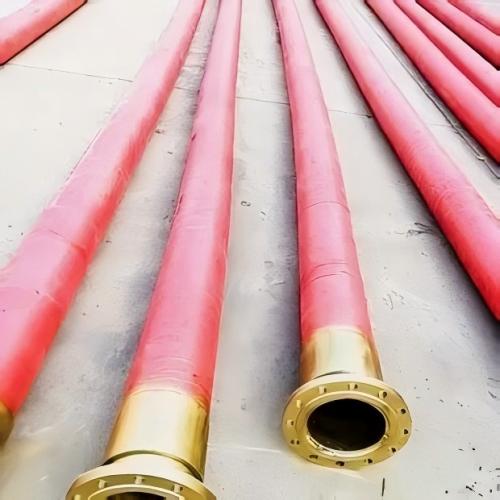
Long-Service-Life API Petroleum Drilling and Production Hoses Resistant to Water-Based Mud Abrasion
Gradient Wear-Resistant Composite Liner: Targeted Defense Against Intense Abrasion
Most standard oilfield drilling hoses utilize a liner made from a single, conventional nitrile rubber compound, which lacks specific optimization for the abrasive nature of water-based mud. When exposed to high-velocity, sand-laden mud, the surfaces of these liners are quickly gouged by hard rock cuttings, leading to localized wear-through in a short period. In contrast, this long-service-life, abrasion-resistant hose employs a gradient composite liner structure. By strategically arranging various functional materials—from the innermost layer in direct contact with the mud down to the bonding layer—the design effectively counters both sliding abrasion and particle-impact erosion. Consequently, the overall wear resistance of this liner far surpasses that of standard hoses constructed with a single-material rubber liner. The innermost layer, which comes into direct contact with high-pressure water-based drilling mud, consists of an extruded liner made from highly wear-resistant Ultra-High Molecular Weight Polyethylene (UHMWPE). This material exhibits an abrasion rate only one-fifth that of standard nitrile rubber. Its exceptionally low surface friction coefficient prevents high-velocity quartz sand and rock cuttings from gouging or scratching the surface, thereby fundamentally minimizing the erosive wear caused by hard particles. Furthermore, the ultra-smooth surface of the UHMWPE layer inhibits the adhesion and scaling of clay particles present in the drilling mud. This ensures that the pipe’s internal diameter remains constant and flow resistance does not increase over time, maintaining a stable, long-term flow rate for the drilling mud.
Beneath the wear-resistant UHMWPE layer lies a highly elastic natural rubber buffer layer. When large rock cuttings within the drilling mud strike the pipe wall at high velocity, this elastic layer undergoes rapid deformation, converting the kinetic energy of the impact into heat—which is then dissipated—thereby preventing the UHMWPE layer from cracking or spalling due to direct, rigid impacts. This effectively overcomes the inherent limitation of insufficient impact resistance found in single-layer UHMWPE liners. At the base of this gradient-structured liner, a specialized adhesive transition layer is incorporated. This solves the industry-wide challenge of bonding UHMWPE to rubber, ensuring the entire composite liner functions as a cohesive, integrated structure. Consequently, even under the sustained stress of high-pressure drilling mud, the liner remains intact, with no risk of delamination or localized detachment.
Comparative test data indicates that this gradient-structured, wear-resistant composite liner offers a service life more than five times that of a standard nitrile rubber liner. In operations involving the continuous transport of water-based mud with high sand content, the time required for the liner to wear through is extended from several thousand hours to tens of thousands of hours, significantly increasing the overall service life of the hose. The liner’s integrated structure fully complies with the fluid immersion requirements set forth in the API 7K standard; it shows no signs of delamination, swelling, or performance degradation even after prolonged exposure to standard water-based drilling mud at 95°C, making it perfectly suited for the full range of temperature conditions encountered in conventional water-based mud drilling operations. Optimized reinforcement structure for fatigue resistance across the entire hose wall, ensuring structural stability and integrity during long-term operation.
In conventional oilfield drilling and production hoses, the steel-wire reinforcement structure is not specifically optimized for long service life or fatigue resistance. Under the continuous, high-pressure, pulsating impact typical of water-based mud drilling operations, these steel-wire layers are prone to localized stress concentrations. Over time, this leads to wire breakage and bulging of the hose wall—causing the entire hose to fail, even if the inner liner remains intact. This API-compliant, long-service-life hose—designed to withstand abrasion from water-based mud—features comprehensive, fatigue-resistant optimizations across its steel-wire material, winding process, and interlaminar structure. These enhancements significantly boost the long-term pulse-fatigue resistance of the reinforcement, ensuring that the structural lifespan of the hose matches the durability of its wear-resistant inner liner, thereby preventing premature structural failure while the liner is still in good condition.
The reinforcement layers utilize high-toughness, high-strength steel wire specifically engineered for oilfield applications, subjected to specialized drawing and low-temperature tempering. This wire offers over 40% greater resistance to bending fatigue compared to standard wires used in conventional drilling hoses, making it highly resistant to breakage caused by localized stress concentrations during prolonged, repetitive high-pressure pulsing and bending. The winding parameters for the steel wire are precisely optimized through fluid dynamics simulation. Each layer is wound using high-precision, numerically controlled equipment that calibrates tension throughout the process, keeping deviations to a minimum. This ensures a uniform wall thickness and an even distribution of stress across the entire hose, eliminating any weak points prone to localized stress concentration.
High-elasticity, wear-resistant rubber isolation layers are incorporated between the steel-wire layers. These layers prevent direct contact and friction between adjacent wires—which could otherwise lead to internal wear and wire breakage under long-term high-pressure pulsing—while also acting as a stress buffer. By absorbing the alternating stresses generated by high-pressure pulses, these layers further extend the fatigue life of the entire reinforcement structure. The entire wire-wound framework structure has undergone over 300,000 cycles of alternating pressure impulse testing at the rated working pressure. The pipe wall remains completely intact, showing no signs of bulging or broken steel wires. This design supports tens of thousands of hours of continuous operation, with a structural lifespan that perfectly matches the durability of the wear-resistant inner liner, ensuring no premature localized failure.
The outer cover is composed of a highly wear-resistant, modified neoprene rubber formulated specifically for oilfield environments. It incorporates specialized additives that provide resistance to UV radiation, ozone, and corrosion from oilfield wastewater. When used in exposed, outdoor oilfield conditions, the cover resists rapid degradation—such as chalking or cracking—thereby providing a robust protective barrier for the internal wire-wound reinforcement layer. This prevents high-salinity wastewater (common in water-based mud drilling operations) from penetrating and corroding the high-strength steel wires, further enhancing the long-term structural stability of the entire hose.
Designed for long service life and full API compliance, this hose drives cost reduction and efficiency across the entire water-based mud drilling cycle.
In water-based mud drilling, the service life of a hose directly dictates maintenance/replacement costs and losses incurred from unplanned downtime. The frequent replacement of standard drilling hoses has long been a major pain point for oilfield operations. This long-life, abrasion-resistant API drilling hose—designed for water-based mud applications—strictly adheres to the API Spec 7K standard. Every hose undergoes a pressure test at 1.5 times its rated working pressure before leaving the factory, alongside rigorous sampling tests for inner-liner abrasion resistance. Each unit is supplied with comprehensive inspection records and material certification, ensuring full compliance with the entry requirements for various oil and gas fields.
In conventional onshore drilling operations using water-based mud, standard API hoses often require inspection or replacement after every single well. This results in high annual procurement and replacement costs. Furthermore, should the inner liner wear through—leading to a hose burst—the resulting drilling downtime can incur losses amounting to hundreds of thousands of yuan. By utilizing this long-service-life, water-based-mud-abrasion-resistant API drilling hose, the overall operational lifespan is extended to more than five times that of standard products. A single hose can support continuous operations across multiple wells, significantly reducing the frequency of high-pressure hose replacements and eliminating substantial production losses caused by unplanned drilling downtime. In offshore platform environments—where water-based mud is commonly used—this extended service life drastically lowers the frequency of hose replacements, cuts the high costs associated with deploying support vessels for component swaps, and further enhances the overall efficiency of offshore drilling operations.
These hoses can be customized to meet specific requirements for bore size, pressure rating, and length, tailored to the demands of various water-based mud drilling conditions. They come equipped with standard oilfield flanges or union connections, allowing for immediate installation onto existing rig interfaces without the need for complex, additional port machining. For drilling in highly abrasive formations—characterized by a high proportion of hard rock cuttings—the wear resistance of the inner liner can be further upgraded to withstand even more extreme, highly abrasive conditions. During routine maintenance, operators can simply inspect the outer cover for visible signs of wear, bulging, cracking, or aging. By combining these visual checks with periodic pressure testing—in accordance with API 7K inspection standards—the remaining service life of the hose can be quickly assessed, ensuring full compliance with the safety and operational management protocols of oil and gas fields.
For operators engaged in various types of water-based mud drilling, adopting this long-life, abrasion-resistant API drilling hose offers significant advantages. It not only substantially reduces the annual procurement and replacement costs for high-pressure mud transport lines but also eliminates the major safety risks and massive downtime losses associated with the frequent wear-through or bursting of conventional hoses. Ultimately, it provides a highly reliable, API-compliant, and long-lasting flexible conduit solution for high-pressure mud transport in water-based mud drilling operations.