
In fluid transport applications—such as those involving heavy construction machinery, municipal outdoor utility networks, or agricultural irrigation—equipment is often exposed to the elements for extended periods. Standard rubber hoses, when subjected to the combined, persistent onslaught of ultraviolet (UV) radiation, ozone, extreme temperature fluctuations, rain, and salt spray, frequently begin to degrade in under two years. This manifests as surface chalking, cracking, and embrittlement of the hose wall. Such rapid deterioration necessitates frequent replacements, driving up labor and spare-part costs; worse, it can lead to sudden, catastrophic hose bursts during field operations, causing costly production downtime. Engineered for longevity in harsh outdoor conditions, EPDM (ethylene propylene diene monomer) rubber hoses leverage the inherently saturated molecular structure of the base polymer. By optimizing the anti-aging system specifically for extreme outdoor environments, these hoses create a robust, long-lasting protective barrier against a wide range of environmental stressors, offering an exceptionally long service life for fluid transport systems exposed to the open air.
News
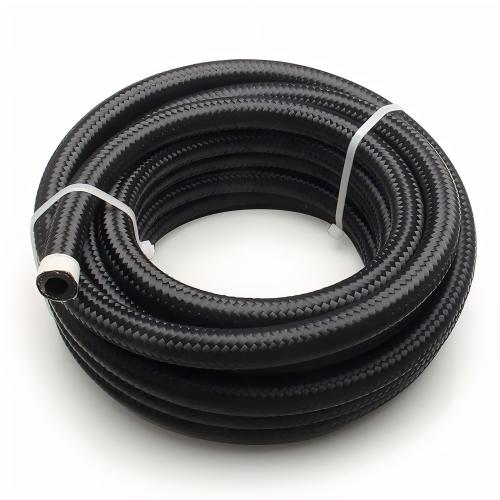
Aging-resistant, long-service-life EPDM rubber hose for outdoor industrial applications
The Saturated Molecular Structure of EPDM: Blocking the Root Causes of Outdoor Aging
The molecular backbone of conventional rubber contains a high density of unsaturated double bonds—vulnerable targets for various environmental aging factors. High-energy UV photons can directly sever these unsaturated molecular chains, while ozone triggers rapid oxidative reactions at the double-bond sites. Furthermore, moisture and salt-spray particles—exacerbated by thermal cycling—can penetrate the gaps within the molecular chains. The synergistic effect of these factors causes a swift decline in the rubber’s mechanical properties, eventually rendering it completely unusable. In contrast, the molecular backbone of EPDM rubber consists of a fully saturated alkane structure. Lacking the unsaturated, reactive sites susceptible to environmental attack, EPDM inherently blocks the primary chemical pathways—photo-oxidation, ozone degradation, and hydrolysis—that lead to material aging.
After five years of exposure to natural outdoor conditions, EPDM rubber retains more than 80% of its original tensile strength and elasticity. It remains free from the extensive cracking, chalking, and flaking commonly seen in standard rubber, offering a service life—in terms of resistance to natural aging—that is 6 to 12 times longer than that of conventional natural rubber. EPDM exhibits an exceptional operating temperature range, maintaining high elasticity consistently between -50°C and 150°C. It remains flexible—neither hardening or becoming brittle in the extreme cold of northern winters, nor softening or turning tacky under the intense, prolonged heat of southern summers—making it perfectly suited for the diverse climatic extremes found across China. Even in harsh outdoor environments—such as high-altitude regions with intense ultraviolet (UV) radiation or coastal areas with high salt-mist exposure—EPDM ages significantly more slowly than conventional rubbers. This inherent molecular advantage, which cannot be replicated in standard rubber materials through simple formulation adjustments, serves as the fundamental basis for this hose’s remarkably long service life in outdoor settings.
A multi-layered, targeted anti-aging modification system creates a comprehensive defense against outdoor environmental degradation.
Relying solely on the intrinsic weather resistance of EPDM is insufficient to meet the requirement for a service life exceeding 10 years. This long-life, anti-aging EPDM rubber hose utilizes a combination of specialized functional additives and optimized structural processing to establish a four-fold, three-dimensional protective system: UV shielding, ozone blocking, hydrolysis retardation, and stress relief. This extends the outdoor service life to more than double that of standard EPDM hoses, far surpassing the performance levels of conventional weather-resistant rubber hoses.
During the compounding phase of the outer rubber layer, surface-modified, high-efficiency UV absorbers and hindered-amine light stabilizers are incorporated. These components work in synergy to provide full-spectrum UV absorption, converting over 95% of the UV energy striking the hose surface into harmless, low-energy heat that is gradually dissipated. This prevents UV radiation from directly attacking the rubber’s polymer chains, significantly slowing the rate of photo-aging. Furthermore, the reinforcement system for the outer rubber layer employs high-structure carbon black—optimized for specific particle-size distribution—which is uniformly dispersed throughout the rubber matrix. This creates a continuous, dense physical barrier that blocks any residual UV radiation from penetrating the material, thereby protecting the deeper structural layers of the hose from UV-induced degradation. The rubber matrix is formulated with a blend of anti-ozonant waxes and chemical anti-ozonants. During long-term use, the anti-ozonant waxes migrate slowly and steadily to the hose surface, forming a continuous, dense, and inert protective film. This film acts as a barrier, completely isolating the rubber from ozone molecules and preventing direct contact that would otherwise trigger oxidative reactions. Simultaneously, the chemical anti-ozonants actively capture any trace ozone molecules that penetrate the rubber, breaking them down into harmless substances and effectively blocking deep-seated oxidative degradation. To combat long-term erosion from outdoor exposure to rainwater and salt spray, the rubber compound incorporates moisture-resistant modifiers. These reduce the water absorption rate of the EPDM rubber by over 70%, hindering the diffusion of moisture and chloride ions—found in salt spray—into the rubber matrix, thereby significantly delaying hydrolysis-induced aging.
All rubber layers within the hose are composed of the same aging-resistant EPDM material, fused at the molecular level through a high-temperature continuous vulcanization process. This results in an inter-layer bond strength far superior to that of hoses constructed from dissimilar rubber layers. Even under the extreme temperature fluctuations typical of outdoor environments, the hose remains free from delamination—a common issue caused by mismatched thermal expansion and contraction coefficients between different layers. This ensures the structural integrity of the entire hose and prevents external aging factors from infiltrating the interior through gaps between layers, further reinforcing the hose's overall resistance to degradation. In accelerated, multi-factor aging tests—simulating 15 years of outdoor exposure—the hose wall remained intact, showing no penetrating cracks, with over 70% of its original mechanical properties retained.
Fully optimized for outdoor environments, this hose offers an exceptionally long service life, drastically reducing overall operation and maintenance costs.
For fluid-conveyance applications requiring long-term outdoor exposure, the frequent replacement of conventional rubber hoses—and the associated procurement costs and operational downtime—has long been a major pain point for users. This long-life, aging-resistant EPDM hose, designed specifically for outdoor use, offers a service life far exceeding that of standard rubber hoses, delivering comprehensive cost savings and enhanced efficiency throughout its entire lifecycle. In the context of auxiliary fluid transport circuits for heavy machinery at open-pit mines, conventional rubber hoses typically fail within one to two years due to outdoor aging and cracking. This not only necessitates significant expenditure on replacement parts but also leads to unplanned equipment downtime—resulting in production losses that far exceed the cost of the hoses themselves. By switching to this long-life, aging-resistant EPDM hose, the service life of the piping system can be extended to over a decade. This drastically reduces the frequency of replacements and effectively eliminates unplanned operational stoppages caused by hose failure in outdoor environments. Similarly, in large-scale municipal irrigation networks, these hoses can be laid out in the open for over ten years without the need for additional shading or protective structures. This significantly lowers both the initial construction costs and the long-term maintenance burden for irrigation infrastructure.
In water supply systems for cleaning equipment at remote, high-altitude photovoltaic (PV) power plants—where intense ultraviolet (UV) radiation often causes standard rubber hoses to crack and degrade in just over a year—this durable EPDM hose offers long-term, reliable performance. It is ideally suited for the harsh, remote conditions of PV sites, substantially reducing the labor costs associated with inspecting and replacing piping in such isolated locations. Furthermore, for temporary water transport in outdoor hydraulic engineering projects or emergency water supply during disaster relief operations, these hoses can be kept in outdoor storage for extended periods. They remain ready for immediate deployment without the need for frequent replacement, as they do not suffer from the aging or degradation typically associated with long-term outdoor exposure. This range of hoses can be customized to meet specific operational requirements, with options for various bore sizes, pressure ratings, and functional attributes. Models formulated with highly wear-resistant additives are ideal for outdoor construction machinery, where frequent dragging would otherwise cause rapid abrasion of the outer layer. Versions enhanced for low-temperature resistance remain flexible even in the extreme cold of high-altitude or high-latitude regions. Meanwhile, large-diameter, fabric-reinforced models are designed for high-flow municipal water transport, capable of handling both high pressure and high volume. During routine maintenance, the condition of a hose can be easily assessed simply by checking the outer surface for visible cracks or signs of degradation (such as chalking)—eliminating the need for complex diagnostic procedures and significantly simplifying pipeline maintenance in outdoor environments.
For users who rely on fluid transport pipelines in long-term outdoor settings, choosing these durable, long-life EPDM rubber hoses offers a dual advantage: it substantially lowers annual procurement costs and minimizes the risk of unexpected operational downtime caused by premature aging or cracking. These hoses provide a reliable, long-lasting solution for fluid transport in any application requiring extended exposure to the outdoors.