
In extreme operating environments—such as those found in chemical smelting, hydrometallurgy, and hazardous waste treatment—where both severe corrosion and high abrasion are present, standard acid/alkali-resistant rubber hoses often fall short. While they may withstand purely corrosive media, the introduction of hard solid particles causes them to erode and wear through rapidly. Conversely, standard wear-resistant hoses quickly degrade when exposed to strong acids or alkalis. Neither type can simultaneously meet the dual requirements of corrosion and abrasion resistance. Industrial-grade, wear-resistant hoses with a UPE (Ultra-High Molecular Weight Polyethylene) liner are engineered specifically for these complex, "corrosion-plus-abrasion" conditions, filling a critical performance gap left by conventional industrial hoses.
News
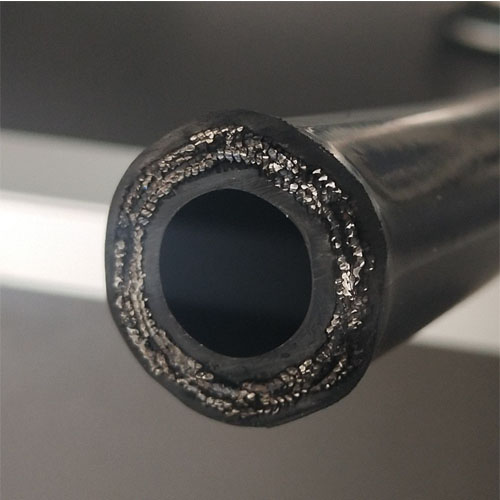
Industrial-grade, wear-resistant rubber hose with a corrosion-resistant UPE liner (resistant to stro
UPE Inert Liner: Delivering Both Strong Acid/Alkali Resistance and Exceptional Wear Resistance
In conventional rubber materials, there is an inherent trade-off between corrosion resistance and wear resistance. Rubber optimized for corrosion resistance tends to be relatively soft and poorly equipped to withstand particle erosion, while rubber designed for high wear resistance typically struggles to endure long-term exposure to concentrated, strong acids or alkalis. The UPE liner in this hose overcomes this performance bottleneck at the material level, successfully achieving both key performance criteria.
As a fully saturated, non-polar polymer, UPE possesses remarkable chemical inertness. It remains unaffected at the molecular level by most concentrated strong acids, strong alkalis, aqueous salt solutions, and even certain highly corrosive chemical agents. Even when submerged for long periods in media with a pH range of 1–14, the material does not suffer from the swelling, degradation, or molecular chain scission commonly seen in standard rubber—offering a level of corrosion resistance that far surpasses that of most conventional acid/alkali-resistant rubber products. With its ultra-long molecular chains—boasting molecular weights in the millions—UPE (Ultra-High Molecular Weight Polyethylene) offers a resistance to particle-induced cutting that far surpasses that of conventional wear-resistant rubber. In identical operating conditions, its service life is 6–8 times longer than that of standard acid/alkali-resistant rubber hoses. Even when strong acids or alkalis contain a high concentration of hard solid particles, the material resists rapid erosion and wear from high-velocity flow—effectively resolving the industry-wide challenge of conventional corrosion-resistant hoses being highly susceptible to abrasive wear from solid particles.
Unlike some products on the market that utilize a thin UPE coating, this industrial-grade hose features a continuous, integrated, thick-walled UPE liner. Extending from one end of the hose to the other without any seams or joints, it eliminates the risk of the coating peeling off or the medium seeping through gaps to corrode the underlying structure. The inner surface of the liner has an exceptionally low coefficient of friction, which prevents solid particles—even in strong acid or alkali environments—from adhering to the walls and forming scale. Consequently, the flow cross-section remains unobstructed over long-term use, ensuring consistent transport efficiency and eliminating the need for frequent disassembly to clear internal deposits.
A fully corrosion-resistant composite structure that eliminates the risk of permeation-induced corrosion
In demanding environments characterized by both strong acids/alkalis and high abrasion, even a high-performance liner can be problematic: if even a small amount of the medium permeates the liner, it can rapidly corrode the internal reinforcement structure, leading to premature failure of the entire hose. This industrial-grade hose employs a comprehensive, multi-layered corrosion-resistant design, creating multiple protective barriers that completely eliminate the risk of structural reinforcement corrosion caused by medium permeation. On the exterior of the UPE liner, a specialized corrosion-resistant isolation/transition layer is applied. Composed of a unique inert material compatible with the UPE liner, this layer serves a dual purpose: it utilizes an activation-bonding process to integrate the UPE liner seamlessly with the outer structure—preventing delamination or separation during long-term use—and acts as a secondary protective barrier. Should a minute amount of strong acid or alkali penetrate the UPE liner under extreme operating conditions, this isolation layer effectively blocks it, preventing any contact with the internal steel-wire reinforcement. The intermediate reinforcement layer consists of a composite weave of high-strength steel wire—subjected to comprehensive corrosion-resistant passivation—and synthetic fibers. Even in the event of extreme media permeation, the passivated steel wires resist short-term corrosion from strong acids or alkalis, preventing rapid degradation such as rusting or hydrogen-induced brittle fracture, thereby ensuring the structural integrity of the entire hose.
The outer cover is crafted from a specialized industrial-grade rubber engineered to resist aging and exposure to strong acid/alkali vapors. In harsh workshop environments saturated with corrosive, volatile acid or alkali mists, the cover remains resistant to rapid erosion and aging; it will not crack, chalk, or flake, even with prolonged exposure. This provides comprehensive protection for the internal reinforcement, shielding it from direct contact with the corrosive external environment and preventing performance degradation. The entire composite structure has been validated through long-term immersion testing in strong acids and alkalis. Under demanding conditions—involving high temperatures (80°C), exposure to strong acids and alkalis, and mechanical wear—the various layers remain intact. The hose avoids common failure modes such as inner-layer swelling, corrosion of the reinforcement, or fragmentation of the outer cover, fully meeting the rigorous requirements for continuous industrial operation.
Purpose-built for diverse operating conditions, significantly reducing operational and maintenance costs.
The composite performance of this UPE-lined, acid/alkali-resistant, and wear-resistant hose is precisely engineered for extreme operating conditions that exceed the capabilities of standard hoses. Across a wide range of industrial applications, it delivers a service life far surpassing that of conventional products, fundamentally lowering total operational and maintenance costs in complex, demanding environments. In hydrometallurgical operations, where slurries contain both high concentrations of strong acids and large quantities of hard metallic ore particles, standard rubber hoses often fail within weeks due to corrosion and abrasion. In contrast, this specialized hose offers years of stable, continuous service, significantly reducing the frequency of pipeline replacements at remote metallurgical sites. In chemical smelting—specifically when transporting acidic waste slurries laden with iron oxide scale—the hose’s UPE (Ultra-High Molecular Weight Polyethylene) liner resists both acid corrosion and the erosive wear caused by hard iron oxide particles, preventing production line interruptions otherwise necessitated by frequent hose replacements. Similarly, in the hazardous waste treatment sector, where sludge often contains a complex mix of highly corrosive substances and solid debris, this hose withstands both chemical corrosion and mechanical abrasion, substantially lowering the safety and environmental risks associated with hazardous waste leaks.
Furthermore, these hoses can be customized to meet specific pressure requirements—ranging from large-diameter, low-pressure configurations to medium- and high-pressure specifications. The accompanying couplings are also treated for high corrosion resistance, eliminating the rapid degradation and leakage common with standard carbon steel fittings and ensuring that connection points do not become the weak link in the entire piping system. For industrial enterprises operating under such extreme conditions, the primary benefit of adopting these wear- and corrosion-resistant industrial hoses is a significantly extended service life. This reduces direct costs—such as frequent procurement and downtime for replacements—and, more importantly, eliminates the risk of sudden leaks of highly corrosive materials, which could otherwise lead to severe safety or environmental incidents, costly production stoppages, and regulatory compliance issues. During routine maintenance, simple visual inspections of the outer layer, combined with basic wall-thickness measurements, allow for an accurate assessment of the remaining wear margin of the UPE liner. This enables proactive replacement scheduling, effectively eliminating the danger of unexpected leaks. As modern industry increasingly demands safer fluid transport under complex, extreme operating conditions, specialized industrial hoses—designed to simultaneously address the dual challenges of severe corrosion and high abrasion—are progressively replacing conventional, single-function hoses. These advanced hoses provide a highly reliable safety barrier for fluid transport in demanding environments, such as hydrometallurgy, chemical processing, and hazardous waste treatment.