
In oilfield cementing and workover operations, fluid-conveying hoses are frequently subjected to extreme temperature fluctuations—ranging from frigid outdoor conditions in winter to the continuous flow of high-temperature fluids returning from the wellbore, as well as the thermal shock caused by alternating between hot and cold media. Standard drilling and production hoses are prone to brittle fracture at low temperatures or softening and delamination at high temperatures. Such failures can lead to operational interruptions or, in more severe cases, catastrophic safety incidents involving the high-pressure discharge of fluids. Designed specifically for oilfield cementing and workover applications, these API-compliant, temperature-resistant hoses are engineered to withstand extreme thermal conditions. Through optimized material formulations and structural design, they serve as critical, safe conduits for fluid transport in environments characterized by complex temperature variations.
News
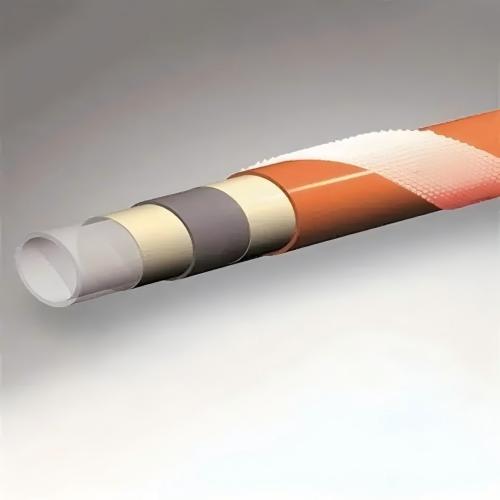
API-compliant rubber hoses for oilfield cementing and workover operations, designed for high and low
Specialized, Modified Base Materials for a Broad Temperature Range
While the rubber compounds used in conventional drilling and production hoses are typically limited to moderate temperature ranges—losing molecular stability under extreme conditions—these hoses are engineered from the material formulation stage to overcome such thermal limitations, fully meeting the rigorous temperature-resistance requirements set by API standards for petroleum-industry hoses.
The inner liner, which comes into direct contact with substances such as cementing slurries, workover/well-kill fluids, and crude oil, is composed of a specialized, saturated rubber base material modified for both high and low-temperature resistance. By fine-tuning the polymerization process and cross-linking density of the polymer chains, the molecular structure remains highly stable even under extreme temperatures. In cold environments, the rubber avoids the common issues of hardening, embrittlement, and cracking upon bending; even in the sub-zero conditions of northern oilfields—reaching as low as -40°C—the hose retains sufficient elasticity, ensuring that bending during setup or dragging across the site does not cause the pipe wall to crack. Under high-temperature conditions, the inner liner resists rapid softening, tackiness, and the degradation of mechanical properties. It can withstand the continuous flow of high-temperature fluids returning from the wellbore without experiencing swelling, delamination, or the adhesion of cement slurry to the pipe walls. Unlike some products on the market that rely on the simple addition of inexpensive plasticizers to achieve short-term low-temperature flexibility, this hose features a temperature-resistant formulation validated through rigorous testing—including long-term thermo-oxidative aging and low-temperature cold-bending tests—as per API standards. Even during extended service in extreme temperatures, the hose remains free from issues such as plasticizer migration or molecular chain degradation. It maintains consistent performance across a wide temperature range, ensuring no premature failure—such as a sudden loss of toughness or a sharp decline in high-temperature strength—after prolonged use. Furthermore, the inner rubber layer is engineered for both oil resistance and durability against abrasion from cement slurries. It resists rapid wear or breakthrough when conveying high-sand-content cement slurries during cementing operations, and remains unaffected by swelling or corrosion when exposed to various crude oils or chemical additives used in well-servicing operations—delivering a triple-threat combination of temperature, corrosion, and abrasion resistance.
Steel-wire-reinforced carcass optimized for extreme temperatures, ensuring sustained pressure-bearing capacity
Optimizing the rubber material alone is insufficient to meet the high-pressure demands of cementing and well-servicing operations. Consequently, the hose’s internal reinforcement carcass has been specifically strengthened for extreme temperature conditions. This ensures that the hose’s pressure-bearing capacity remains stable across the entire operating temperature range, without significant degradation due to temperature fluctuations.
The reinforcement layer consists of multiple plies of high-strength, high-toughness specialty steel wire, applied in a cross-wound configuration. These wires are inherently resistant to thermal shock; they do not suffer from the low-temperature embrittlement typical of standard carbon steel in frigid environments, nor do they experience a significant loss of strength under high-temperature conditions. By precisely controlling the winding angle and distribution density of each layer of steel wire, a three-dimensional, uniform load-bearing network is created. During high-pressure, high-flow-rate cement slurry delivery in cementing operations—even when the medium undergoes significant temperature fluctuations—the dual or multi-layer steel wire reinforcement effectively distributes high-pressure loads. This eliminates the risk of pipe bursts caused by localized stress concentrations, ensuring the hose maintains its rated working pressure across its entire specified temperature range, without issues such as insufficient pressure-bearing capacity at low temperatures or softening of the reinforcement structure at high temperatures.
Between each pair of steel wire layers, a specialized synthetic fiber buffer/isolation layer—resistant to both high and low temperatures—is incorporated. This prevents wire breakage caused by direct contact and friction between adjacent layers, further optimizes stress distribution, and absorbs differential deformation between materials during rapid temperature changes. This prevents delamination that could otherwise occur due to the differing thermal expansion and contraction coefficients of the rubber and steel wire. The outer cover is composed of a specially modified rubber compound that resists extreme temperatures and the aging effects typical of oilfield environments; it will not soften, become sticky, or suffer a sharp decline in mechanical properties when exposed to intense summer sun, nor will it become brittle, crack, or flake off in extreme winter cold. This provides comprehensive protection for the internal steel wire reinforcement, preventing exposure to the environment that could lead to corrosion and performance degradation. The entire composite structure has undergone high- and low-temperature alternating pressure pulse testing in accordance with API standards. Even after hundreds of thermal cycles, the hose’s burst pressure remains above 90% of its original design value—demonstrating structural stability far superior to that of conventional drilling and workover hoses.
API-standardized coupling assemblies, covering the full spectrum of cementing and workover requirements.
In the high-pressure environments characteristic of cementing and workover operations, over 80% of potential leakage issues occur at connection points. The coupling assemblies paired with this hose strictly adhere to API specifications for petroleum-industry hoses. They feature specialized sealing optimizations designed for high- and low-temperature conditions, effectively resolving the challenge of connection leaks caused by temperature fluctuations. The high-pressure couplings are forged from high-strength alloy as a single, seamless unit, eliminating the risk of weld cracking caused by thermal shock. Internally, the couplings feature a multi-layered, barbed interlocking structure; through a high-precision CNC swaging process, these barbs are embedded directly into the steel-wire reinforcement of the hose. This creates a rigid, integrated connection between the coupling and the hose, effectively preventing the hose from detaching from the coupling—a critical failure that could otherwise occur under fluctuating temperature conditions. The sealing components within the couplings are crafted from specialized, temperature-resistant materials that maintain consistent elasticity across a broad range of -40°C to 120°C. This ensures they neither harden and lose elasticity in extreme cold nor soften and fail in high heat, thereby eliminating the risk of leaks at connection points due to temperature fluctuations. Before leaving the factory, every hose assembly undergoes a pressure-retention test at 1.5 times its rated working pressure—in accordance with API standards—along with additional sealing verification under both high and low-temperature conditions, ensuring complete reliability even in extreme operating environments.
In practical oilfield operations, these hoses are well-suited for a variety of demanding, core applications. During winter cementing operations in frigid outdoor conditions, the hoses remain flexible and resistant to brittle fracture, ensuring they can withstand high-pressure cement slurry pumping without bursting or leaking. In well-servicing operations, they are used to transport high-temperature well-flushing or kill fluids; even with prolonged exposure to such high-temperature media, the inner lining remains intact, and the structural reinforcement does not fail. Furthermore, in unconventional well-servicing tasks involving the alternating transport of hot and cold media, the hoses maintain structural stability despite repeated thermal shocks. The available hose lengths are specifically tailored to the operational requirements of cementing and well-servicing sites. They serve effectively as high-pressure, flexible connectors between cementing pumps and manifolds—absorbing equipment vibrations to extend the service life of rigid piping—and as high-pressure, flexible transfer lines at the wellhead, accommodating axial displacement between various pieces of equipment. For oilfield operations teams, selecting these API-compliant, high- and low-temperature resistant hoses—specifically designed for drilling and production—offers significant advantages. They enhance adaptability to extreme conditions during cementing and workover operations, reduce the likelihood of sudden hose failure in high- or low-temperature environments, and minimize unplanned operational downtime caused by hose malfunctions. Furthermore, they help prevent safety and environmental risks associated with the leakage of high-pressure media. By following API standards for routine maintenance—including periodic pressure testing, inspections for external wear, and checks on the condition of seals—these hoses can ensure long-term, stable performance, establishing a robust, high-pressure, and temperature-resilient safety barrier for oilfield cementing and workover operations.