
During hydraulic fracturing operations, proppants—such as quartz sand and ceramic beads—carried by the fracturing fluid scour the pipe walls at speeds ranging from several meters to over ten meters per second, causing continuous "abrasive wear" on the hose liner. Under these conditions, conventional rubber liners develop significant wear grooves within just a few hundred hours, creating a bottleneck for operational continuity. UPE (Ultra-High Molecular Weight Polyethylene) liners represent a material innovation specifically designed to address this wear issue: they utilize ultra-long molecular chains (with molecular weights in the millions) to form an erosion-resistant barrier, employ chemical inertness to withstand acid corrosion, and incorporate multi-layer steel wire reinforcement to handle ultra-high-pressure pulses, thereby serving as a reliable, abrasion- and acid-resistant conduit for shale gas fracturing.
News
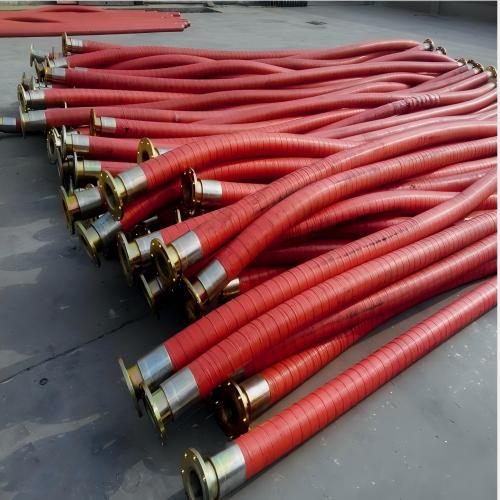
API Oil Drilling and Production Hoses; Ultra-Wear-Resistant Hydraulic Fracturing Hoses; UPE Liner; R
I. The Secret to UPE’s Erosion Resistance: Molecular Chain Structure and Abrasive Wear Mechanisms
Abrasive wear is the primary mechanism by which fracturing fluid damages the inner wall of the hose. Driven by high pressure, proppant particles—possessing Mohs hardness values of 7 (quartz sand) and 8–9 (ceramic beads)—scour the inner wall at high speeds; the resulting damage is a classic form of liquid-solid two-phase flow erosion. The wear rate is directly correlated with flow velocity, particle hardness, and particle concentration; for instance, increasing the proppant concentration from 40 kg/m³ to 210 kg/m³ can cause the erosion rate to rise by approximately 2.3 times.
UPE’s status as the preferred liner material for resisting proppant erosion stems from its unique molecular structure. With a molecular weight ranging from 3 million to 7.5 million g/mol, UPE exceeds that of standard polyethylene by more than tenfold. These ultra-long molecular chains form a highly entangled network; when abrasive particles impact the inner wall, the UPE chains dissipate the kinetic energy of the impact as heat generated by internal molecular friction—facilitated by a "slip-and-rearrange" process—rather than undergoing direct chain scission. This mechanism enables UPE to achieve wear resistance three to five times that of ordinary rubber; under extreme operating conditions with a sand content of 30%, its service life can extend beyond 8,000 hours.
UPE also possesses excellent chemical inertness. Its molecular backbone consists of saturated carbon-carbon single bonds, free from the unsaturated bonds or polar groups susceptible to chemical attack, granting it inherent resistance to strong acids and alkalis (pH 1–14). In acid fracturing applications, the UPE liner withstands long-term exposure to 28% hydrochloric acid without swelling or degrading during the transport of acid-based fracturing fluids, effectively resolving the issue of rapid failure common to traditional rubber liners in acidic environments.
II. Multi-layer Steel Wire Winding: A Mechanical Framework for Ultra-High-Pressure Pulses
While the UPE liner provides a barrier against wear and acid, the structural capacity to withstand the ultra-high pressures of fracturing operations relies on the reinforcement layer. The API 7K standard classifies fracturing hoses into pressure ratings of 5,000 psi, 10,000 psi, 15,000 psi, and 20,000 psi, catering to the distinct requirements of conventional fracturing, deep shale gas fracturing, and ultra-deep well operations.
The reinforcement layer utilizes a structure of four to ten layers of high-strength, ultra-flexible steel wire or steel cable wound in alternating spirals. Adjacent layers are wound in opposing directions to form an "interlocking" mechanical framework: inner steel wire layers provide radial support at a steeper angle to resist hose expansion under ultra-high pressure, while outer layers form an axial tensile framework at a shallower angle to prevent excessive hose elongation under pressure pulses. High-adhesion intermediate rubber layers bond the structure into a solid, unified whole, ensuring even stress distribution across the multi-layer assembly and preventing interlayer delamination caused by stress concentration. Taking the 15,000 psi (approx. 103.5 MPa) rating as an example, the API 7K standard requires a verification pressure of 1.5 times the working pressure (22,500 psi) and a burst pressure of no less than 2.5 times the working pressure (37,500 psi). Empirical data from companies like Litong Technology show that their 2-inch products can achieve a burst pressure of 40,000 psi (approx. 276 MPa), offering a substantial safety margin. Regarding impulse fatigue, the standard requires the hose to withstand over 5,000 cycles at high pressure without failure; however, high-quality products can achieve an impulse life exceeding one million cycles.
A full-bore, full-flow design is another key feature of UPE-lined fracturing hoses. The inner wall is free of steps or diameter reductions, ensuring minimal flow resistance for proppants and eliminating the risk of proppant accumulation and clogging—issues often caused by flow restrictions in traditional rigid manifolds. This design significantly enhances fracturing fluid delivery efficiency while reducing the pumping energy consumption of the fracturing fleet.
III. Adaptation to Fracturing Scenarios: From Wear Warnings to Full-Lifecycle Safety Management
The practical value of UPE-lined, ultra-wear-resistant fracturing hoses in shale gas operations is further demonstrated through two dimensions: "visualized service life management" and the operational efficiency gains achieved by "replacing steel with flexible hoses."
The design incorporating a wear-warning layer addresses the industry-wide challenge of determining exactly when to replace fracturing hoses. A colored warning layer is integrated beneath the UPE liner; when the inner UPE layer wears down to a critical threshold, the red warning layer becomes visible. This allows operators to visually assess the hose's remaining service life, marking a shift from reactive responses to burst failures to proactive, early-warning management. This design is particularly crucial for high-sand-content fracturing operations, providing a quantifiable basis for on-site safety management.
The efficiency revolution of replacing rigid steel pipes with flexible hoses represents the core competitive advantage of UPE fracturing hoses. Compared to traditional steel pipe manifolds, the hose solution offers significant advantages: installation efficiency is more than doubled, costs are reduced by 70%, and the number of high-pressure swivel joints required is drastically lowered. Utilizing integral union or flange connections, the hoses minimize connection points, thereby eliminating the high-pressure leakage risks associated with the multiple elbows found in steel pipe assemblies. Weighing only 30% of equivalent steel pipes, they greatly simplify lifting and handling operations at the job site.
Field validation confirms the successful deployment of UPE-lined fracturing hoses in projects across Middle Eastern oilfields, North American shale gas fields, and Chinese shale gas demonstration zones, with over 2 million hours of safe operation recorded. Data from North American shale gas fields show an average service life exceeding 1,200 hours per well, with a 40% reduction in replacement frequency compared to similar products.
In summary, the UPE-lined, ultra-wear-resistant hydraulic fracturing hose perfectly meets the systematic requirements of shale gas fracturing—specifically abrasion resistance, acid corrosion resistance, and high-pressure capability. It achieves this through three core technologies: a molecular-level erosion and acid-corrosion barrier provided by the Ultra-High Molecular Weight Polyethylene (UPE) liner; an ultra-high-pressure load-bearing structure featuring 4–10 alternating layers of steel wire winding; and a full-lifecycle safety management system incorporating a wear-warning layer and a full-bore design. From 8,000-hour wear-resistance validation and a 40,000 psi burst safety margin to chemical inertness against 28% hydrochloric acid and a 70% cost saving by replacing rigid steel with flexible hose, every micron of the UPE liner and every layer of steel wire winding serves a single goal: ensuring the safe, reliable, and durable transport of fracturing fluids and proppants during reservoir stimulation operations thousands of meters underground.