
In the power transmission systems of high-pressure cleaning equipment, ultra-high pressure water jet cutting machines, and heavy-duty hydraulic tools, hoses not only need to withstand continuous high-pressure impacts, but also need to maintain structural integrity in frequent bending and vibration environments. Ordinary rubber hoses are prone to aging and degradation under such working conditions, while metal hard pipes lack flexibility and are difficult to adapt to the needs of mobile devices. PTFE (polytetrafluoroethylene) high-pressure hose is a systematic solution for this composite working condition - using the chemical inertness and extremely low friction coefficient of PTFE material body to ensure the purity and low flow resistance of the medium, carrying a working pressure of 35MPa (about 5075psi) and 4 times the explosion safety redundancy with multi-layer high-strength stainless steel wire weaving/winding structure, covering the entire scene from extreme cold to high temperature cleaning with an ultra wide temperature range of -70 ℃ to 260 ℃, becoming a reliable channel for power transmission of high-pressure cleaning equipment and hydraulic tools.
News
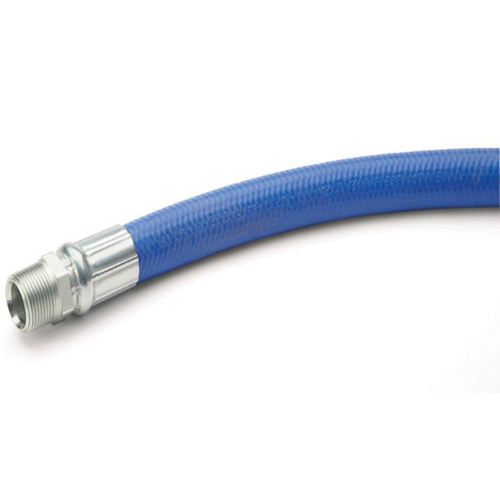
PTFE high-pressure hose working pressure 35MPa high-pressure cleaning equipment and hydraulic tools
1、 Structural bearing capacity of 35MPa pressure level: Multi layer steel wire reinforced mechanical architecture
35MPa (approximately 5075psi) is a typical working pressure level for industrial high-pressure cleaning and medium hydraulic systems, covering a wide range of application scenarios from high-pressure unloading of chemical reaction vessels, high-pressure water jet cleaning to power transmission of hydraulic tools. To achieve long-term stable load-bearing under this pressure level, strict requirements have been put forward for the structural design of the reinforcement layer.
The reinforcement layer of this grade PTFE hose adopts a multi-layer 304/316L stainless steel wire weaving or spiral winding structure. Unlike single-layer weaving, multi-layer reinforced structures disperse stress through the coordinated deformation of each layer of steel wire - the inner layer of steel wire provides radial support at a higher winding angle to resist tube bulging under high pressure; The outer steel wire constructs an axial tensile skeleton at a lower angle to prevent excessive elongation of the hose under pulse pressure. The interlayer ensures uniform distribution of steel wires through precise tension control, avoiding local fatigue caused by stress concentration.
Based on this structure, the burst pressure of PTFE high-pressure hoses is usually more than 4 times the working pressure. Taking the 35MPa working pressure level as an example, the minimum burst pressure reaches 140MPa or above, providing ample safety margin for instantaneous overpressure caused by water hammer effect or rapid valve closure in the system. Some heavy-duty models can adapt to harsh environments such as high impact and high vibration, and withstand continuous pressure pulses and cyclic loads.
2、 Dual protection of PTFE inner layer: synergistic advantages of corrosion resistance and low flow resistance
The inner layer of PTFE high-pressure hose is made of high-purity PTFE seamless extruded tube, and its carbon fluorine bond molecular structure endows the material with almost "universal" chemical inertness, which can safely transport sulfuric acid, hydrochloric acid, hydrofluoric acid, aqua regia and various organic solvents without swelling, degradation or precipitation of pollutants.
In high-pressure cleaning and hydraulic systems, this chemical inertness ensures that the inner layer of the hose will not experience particle shedding or surface degradation due to medium erosion, thereby protecting downstream precision components such as high-pressure nozzles and hydraulic valve cores from contamination. At the same time, the extremely smooth inner wall of PTFE (friction coefficient of about 0.04) minimizes fluid transport resistance, effectively reducing pressure drop and energy loss along the way at a high pressure of 35MPa, and improving system efficiency.
For working conditions where non-conductive media (such as oil and solvents) may accumulate static electricity during transportation, using black anti-static PTFE lining can control the surface resistance within a safe range and eliminate safety hazards caused by electrostatic discharge. The smooth and non adhesive properties of the inner layer material also make the hose easy to clean during medium switching. Models that comply with FDA and USP Class VI certifications can be directly used in high-pressure cleaning scenarios in the food and pharmaceutical industries.
3、 Wide temperature range applicability and end connection: full working condition adaptation for high-pressure scenarios
The working temperature range of PTFE high-pressure hoses covers -70 ℃ to+260 ℃, making their adaptability significantly better than conventional hoses in extreme environments. The low-temperature end of -70 ℃ corresponds to the hydraulic pipelines of polar equipment or liquid nitrogen cooling systems. PTFE will not become brittle and glass like ordinary rubber in extremely low temperature environments; The high temperature of 260 ℃ corresponds to the continuous operation of high-temperature cleaning equipment, steam tracing pipelines, and thermal hydraulic circuits. PTFE is one of the few polymer materials that can maintain chemical stability for a long time above 200 ℃ without accelerating aging.
This wide temperature range feature enables the same hose to simultaneously meet the cold start requirements of high-pressure cleaning equipment in high temperature effluent in summer and cold environment in winter, simplifying spare parts management in different climate regions.
The end connection and crimping process also affect the long-term reliability of 35MPa grade hoses. The joint is usually made of 316 stainless steel material, and the PTFE lining is extended to the sealing surface of the flange or threaded joint through the expansion and flanging process, ensuring that the medium flow path is completely covered by PTFE and eliminating the risk of metal parts coming into contact with corrosive media. The clamping amount needs to be precisely controlled within the process tolerance range - excessive deviation may cause the joint to detach or leak under high voltage pulses, while insufficient deviation may damage the inner tube and cause stress cracking. Some products adopt a double-layer reinforcement structure of "winding+weaving" to further enhance the fatigue resistance of the joint area, and maintain the integrity of the connection during frequent bending high-pressure cleaning operations.
In summary, the PTFE high-pressure hose with a working pressure of 35MPa perfectly meets the systematic requirements of high-pressure cleaning equipment and hydraulic tools for "high pressure resistance, corrosion resistance, and wide temperature range" with its multi-layered stainless steel wire reinforced 4-fold explosion safety redundancy, chemical inertness and ultra-low flow resistance characteristics of the PTFE inner layer, and full scene adaptation to temperatures ranging from -70 ℃ to 260 ℃. From high-pressure unloading of chemical reaction vessels to frequent bending of high-pressure water jet cleaning, from pulse impact of hydraulic tools to stable start-up in -70 ℃ extremely cold environment, the design of each layer of steel wire weaving and every millimeter of PTFE inner wall points to the same goal: to provide a reliable channel for industrial equipment that does not leak, corrode, or fail in the harsh transmission of high-pressure media.