In the fields of industrial rust removal and cleaning, ship maintenance, and hydraulic fracturing of concrete, ultra-high pressure water jet technology with a pressure of 320MPa (approximately 46400psi) is gradually replacing traditional sandblasting and mechanical crushing processes. The conveying hose that carries this ultimate pressure not only needs to withstand continuous mechanical pulse impact, but also needs to remain intact in harsh working conditions such as dragging on rough ground, sharp angle friction with steel structures, and contact with residual chemical substances. The polyurethane outer layer ultra-high pressure cleaning hose is a systematic solution for this scenario - using nylon/POM inner layer to ensure low resistance medium channels, using multi-layer steel wire winding to carry ultra-high pressure pulses, and using ultra wear-resistant polyurethane outer sheath to resist on-site wear and chemical erosion, becoming a reliable channel that combines "pressure bearing" and "durability" in the fields of ship rust removal and industrial cleaning.
News
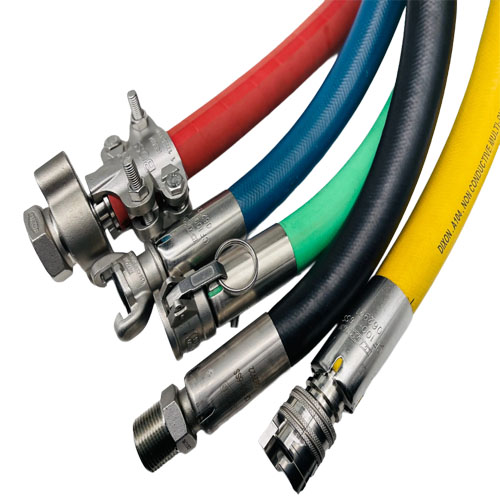
Ultra high pressure cleaning hose with polyurethane outer layer, wear-resistant and temperature resi
1、 Polyurethane outer layer: a wear-resistant solution from "easy to wear through" to "durable"
The wear mechanism of the outer sheath of hoses in industrial cleaning sites covers multiple levels: continuous drag and friction between rough concrete and metal floors, repeated contact with sharp edges of steel structures, impact of gravel particles carried by high-pressure water flow rebound, and erosion by oil stains, chemical solvents, etc. [citation: 3]. The ordinary outer rubber layer wears through in such working conditions for several months, followed by rainwater and sediment invading the reinforcement layer, steel wire rusting, and a sudden reduction in pulse life, ultimately leading to the premature scrapping of the entire hose.
The outer layer of polyurethane (PU) is currently the core solution to solve the problem of wear resistance. The polyurethane material on the outer layer of the ultra-high pressure cleaning hose has extremely high wear resistance, weather resistance, and corrosion resistance, and is not easily damaged when dragged or rubbed during cleaning operations. Actual test data shows that the wear resistance index of polyurethane can reach 3-5 times that of natural rubber, and the wear amount under the same friction conditions is only 20-30% of the latter. The Parker PFX30 series adopts ToughJacket ™ Polyurethane outer layer technology enhances wear resistance while utilizing ColorGard ™ The outer wear indicator system enables intuitive monitoring of the wear status, allowing operators to easily check the corrosion of the core tube, improve inspection efficiency, and reduce unplanned downtime.
The multi-layer protective structure further enhances the durability of the outer layer. Some high-end products adopt a double-layer structure on the outer layer - the inner layer is made of yellow nylon to provide basic protection, and the outer layer is made of red polyurethane to achieve comprehensive protection against wear, weathering, and ozone. When the outer layer shows wear and tear, it can be alerted in advance through color changes, providing a visual tool for on-site safety management.
2、 Wide temperature range adaptation: full scene operation capability from -40 ℃ to 100 ℃
The geographical span of industrial cleaning operations is enormous - from outdoor shipyards in the north during winter to cabins in the south during summer, from low-temperature workshops to high-temperature environments inside equipment chambers. Ordinary hoses are prone to outer layer hardening, brittle cracking, or softening deformation under extreme temperature differences.
The 320MPa cleaning hose maintains stable physical properties within a wide temperature range of -40 ℃ to+100 ℃. Polyurethane materials themselves can maintain high flexibility at low temperatures and will not crack due to embrittlement; In high temperature environments, the molecular chain stability of the outer polyurethane ensures that it will not soften or deform, providing reliable protection for the internal reinforcement layer. The temperature adaptation range of some products can even be extended to -40 ℃ to+120 ℃, further covering the full range of requirements from extreme cold to high heat.
This wide temperature range characteristic enables the hose to serve stably in different weather conditions such as ship rust removal, building demolition, and industrial equipment maintenance, without the need to replace hoses of different specifications due to seasonal or regional changes, simplifying on-site spare parts management.
3、 Three layer composite structure: system integration from low resistance inner tube to weather resistant outer layer
The excellent performance of ultra-high pressure cleaning hoses comes from the precise coordination of the three-layer structure of "inner layer reinforcement layer outer layer".
The inner layer is made of nylon (PA) or polyoxymethylene (POM) resin, which has excellent chemical corrosion resistance and low friction coefficient, effectively resisting the erosion of high-speed water jets. The nylon inner layer is less prone to creep deformation under ultra-high pressure of 320MPa (about 46400psi), has a low volumetric expansion rate, and has better dimensional stability than traditional rubber inner lining during pressure fluctuations. The smooth characteristics of the inner wall result in minimal resistance along the way when high-pressure water flows through, effectively reducing pressure drop and energy loss.
The reinforcement layer is composed of 4 to 8 layers of high-strength steel wire spiral winding, which is the core of the hose to withstand a working pressure of 320MPa and achieve a burst pressure of 800MPa. Compared to woven structures, multi-layer winding structures have higher resistance to explosion and pulse, maintaining structural stability in frequent start stop pressure cycles. The inner layer of steel wire provides radial support at a higher angle, while the outer layer constructs an axial tensile skeleton at a lower angle. The interlayer is formed as a whole through a high bonding medium.
The outer layer is made of ultra wear-resistant polyurethane (PU), which protects the internal reinforcement layer from mechanical damage and environmental erosion. The outer layer of polyurethane also has the characteristics of ozone resistance and UV resistance, and is not easily aged under long-term outdoor exposure. The polyurethane outer layer schemes of different products have their own focuses: some use single-layer black polyurethane to achieve basic wear-resistant protection, while others use a double-layer structure (nylon inner layer+polyurethane outer layer) to achieve the composite function of wear resistance and visual warning.
In summary, the ultra-high pressure cleaning hose with a polyurethane outer layer and a temperature resistance of -40~100 ℃ perfectly meets the systematic requirements of industrial rust removal and cleaning for "wear resistance, weather resistance, and long-term reliability" with three core technologies: 3-5 times the wear resistance life of its ultra wear-resistant polyurethane outer layer, 800MPa explosive redundancy with multi-layer steel wire winding, and wide temperature range stable service with a three-layer composite structure. From chemical pollution free cleaning for ship rust removal to a 20 fold increase in efficiency for hydraulic dismantling, from -40 ° C extreme cold shipyards to 100 ° C high-temperature cabins, every layer of polyurethane protection and every layer of steel wire winding point towards the same goal: to provide reliable guarantees for water jet transportation that can withstand wear, temperature differences, and chemical erosion at industrial ultra-high pressure cleaning sites.