
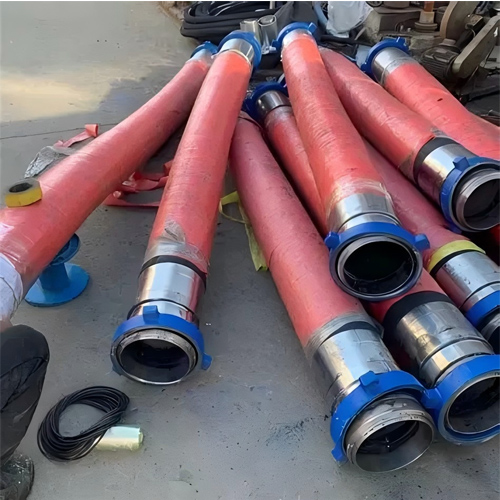
At the shale gas fracturing site, the connection of the high-pressure manifold from the fracturing truck group to the wellhead is a key factor determining the efficiency of the operation. Traditional rigid steel pipes require dozens of movable elbows and flanges to be spliced section by section, with numerous connection points, time-consuming installation, and overlapping leakage risks. The full bore acidizing fracturing hose with an inner diameter of 2 to 6 inches, with its advantages of equal flow design, quick connection, and flexible layout, has become an efficient flexible channel in the "fracturing truck high and low pressure manifold wellhead" link at the fracturing site.
1、 The engineering significance of full diameter equal flow: eliminating the bottleneck of "necking"
The core value of Full Bore design is that the inner wall of the hose has a completely consistent diameter from one end to the other, without any steps, necking, or sudden changes in the inner diameter of the joint.
In traditional segmented pipelines, the local resistance coefficient increases by 0.5-1.0 with each additional joint or elbow. The cumulative effect of multiple connection points can increase the pressure loss of fracturing fluid transportation by more than 20%. Proppants (quartz sand, ceramic particles) are prone to accumulate and block at the necking point at high flow rates, leading to a decrease in displacement and even pipeline collapse. The full bore structure combined with equal bore joint design enables the fracturing fluid to maintain smooth flow even at a flow rate of 15m/s, significantly reducing turbulent noise.
Taking the parameters of Litong Technology's LT301 F series and other products as an example, the flow rate of a 2-inch full bore hose can reach 9 barrels per minute (about 1.46 cubic meters per minute) at a working pressure of 15000psi, and the 4-inch specification can reach 47 barrels per minute (about 7.47 cubic meters per minute), meeting the high displacement requirements for large-scale compression cracking of shale gas single wells. This is the direct contribution of full bore design to the transportation efficiency of the "fracturing truck wellhead" link.
2、 2-6 inch caliber system: a grading scheme adapted to different operating displacements
The wide aperture coverage range with an inner diameter of 2 to 6 inches corresponds to the differentiated flow requirements of shale gas fracturing operations.
2-inch caliber suitable for standard displacement output of a single fracturing truck, commonly used for connecting between levees or branch pipelines; 3-4 inches is the main pipe diameter for zipper operation in cluster wells, which meets the flexibility requirements of high flow and on-site pipe layout; The 5-6 inch diameter is designed as a large displacement main pipeline for large-scale fracturing operations, supporting the convergence and transportation of multiple fracturing trucks in parallel. Taking the 15000psi working pressure level as an example, the minimum bending radius for 2-inch is about 1.4 meters, and for 6-inch it is about 2.3 meters, providing flexibility for the layout of fracturing truck teams while ensuring high flow rates.
3、 Fracturing truck to wellhead link: How flexible connection reshapes on-site efficiency
From the fracturing truck group to the wellhead, the traditional rigid manifold connection method requires segment by segment splicing of flexible elbows, straight pipes, and flange reducers, and single well connection can take up to 2 days. The introduction of full bore flexible hoses has changed this situation, mainly reflected in three aspects.
Manifold connection: both ends of the hose are equipped with an integral union (such as 1502 hammer union) or an integral flange (such as API 15K flange). A single connection can be completed in 3-5 minutes without complicated elbow assembly and flange alignment adjustment. Multiple flexible hoses are connected in parallel between the fracturing truck and the high and low pressure manifold, replacing the segmented splicing of dozens of rigid pipe fittings, which increases installation efficiency by more than twice.
Vibration and displacement compensation link: During the operation of the fracturing truck, the pump body generates continuous mechanical vibration, and the rigid connection will transfer the vibration energy to the wellhead manifold, resulting in loose joints and even fatigue cracking of the weld seam. Flexible hoses absorb pump end vibration and pressure pulsation through the damping energy dissipation mechanism of the reinforcement layer, protecting the long-term reliability of wellhead equipment.
Emergency deployment and dismantling process: The "factory based" fracturing mode of shale gas platforms requires rapid rotation of operations from multiple wells. The flexible hose scheme shortens the movement and redeployment time of the fracturing manifold from days to hours in the rigid scheme, greatly improving equipment utilization and overall operational efficiency.
In summary, the acidizing fracturing hose with a full bore diameter of 2-6 inches has reshaped the efficiency standard of the connection between the fracturing truck and the wellhead manifold through three core technologies: flow resistance elimination and equal flux guarantee of its full bore structure, graded adaptation of the operating displacement with a wide bore diameter of 2-6 inches, and fast connection and flexible compensation of the overall union/flange joint. From a single 3-5 minute connection to a 2-fold increase in efficiency compared to traditional solutions, from a displacement of 9 barrels per minute for 2-inch specifications to over 100 barrels per minute for 6-inch specifications, every connection and every meter of hose laying point towards the same goal: to make high-pressure pipe connections at shale gas fracturing sites faster, safer, and more efficient.