
In the deep development of shale gas, the working pressure of fracturing operations is usually between 70-140 MPa, and the fracturing fluid contains highly corrosive and abrasive media such as hydrochloric acid and quartz sand proppants. The working pressure of 138MPa (20000psi) is already at the top level of the industry, while the burst pressure of 276MPa (40000psi) means that the safety redundancy reaches twice, far exceeding the conventional industrial standard's 1.5 times verification requirement. The acid fracturing hose with a working pressure of 138MPa and a blasting pressure of 276MPa is a specialized solution for this extreme working condition - a super high pressure bearing skeleton is constructed by alternately winding multiple layers of high-strength steel wires, and UPE lining is used to resist the dual erosion of strong acid and abrasive particles. The API 7K standard certification and full bore design ensure the safety and efficiency of shale gas fracturing operations.
News
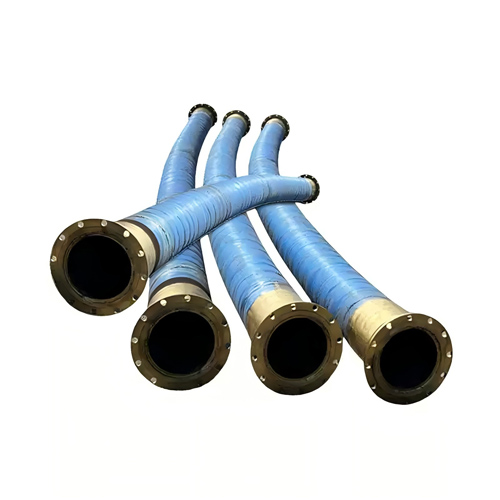
Acidic fracturing hose with working pressure of 138MPa and bursting pressure of 276MPa, specifically
1、 Standard positioning and bearing logic of 138MPa working pressure
138MPa (approximately 20000psi) is in the highest pressure range in the standard system of fracturing hoses. The API 7K standard divides fracturing hoses into pressure levels of 5000psi, 10000psi, 15000psi, and 20000psi, with 20000psi specifically designed for ultra deep wells and deep shale gas fracturing. The blasting pressure of 276MPa means that the verification pressure is 207MPa (1.5 times the working pressure), and the blasting safety factor is 2 times. This design benchmark places extremely high demands on the mechanical properties of the reinforcement layer.
The reinforcement layer adopts a 4-10 layer high strength steel wire alternating spiral winding structure, and adjacent layers are wound in alternating directions to form an "interlocking" mechanical skeleton. Patent technology shows that by precisely controlling the winding angle of each layer (increasing from 53.50 ° in the inner layer to 54.37 ° in the outer layer) and the number of wire layers, the blasting pressure can reach the design target value. The steel wire layer is divided into an inner layer and an outer layer - the inner layer has a steel wire strength of 1630-150MPa and an elongation rate of ≥ 5%, while the outer layer has a steel wire strength of 2150-2750MPa and an elongation rate of ≥ 1.6%. Through a graded design of "inner flexibility and outer rigidity", a balance is achieved between ultra-high pressure bearing and pipe flexibility.
2、 UPE lining: a chemical barrier resistant to 28% hydrochloric acid and abrasion particles
The fracturing fluid contains 15-28% hydrochloric acid and proppants such as quartz sand, which cause a dual impact of chemical corrosion and abrasive wear on the inner wall of the hose. UPE (ultra-high molecular weight polyethylene) lining has stable tolerance to 28% hydrochloric acid at room temperature of 20 ℃ due to its saturated molecular chain structure.
The acid fracturing hose lined with UHMWPE imported from Germany/Japan can achieve continuous wear resistance for 8000 hours under sand containing acid conditions. The self-lubricating properties of UPE (friction coefficient 0.07-0.11) further reduce fluid transport resistance and decrease energy consumption during fracturing fluid pumping. The patented technology also designs an anti-seepage layer (PTFE or UPE material) as a second line of defense to prevent strong acidic media from seeping out of the joint and corroding the reinforcement layer, ensuring the structural integrity of the hose during long-term service.
The full bore design is another core feature of the 138MPa fracturing hose. The hose adopts an equal diameter structure, with no steps or shrinkage on the inner wall. When the fracturing fluid and proppant pass through, the flow resistance is extremely small, reducing turbulence and energy loss, and the fracturing fluid transportation efficiency is higher. The joint adopts an integral union or flange configuration, and is combined with the pipe body through an integrated crimping process to ensure that it does not detach under high voltage pulses.
3、 API 7K certification and on-site verification of shale gas fracturing
The API 7K standard is the international entry threshold for shale gas fracturing hoses, which sets strict testing procedures for the pressure rating, pulse life, and corrosion resistance of the hoses. The standard requires the blasting pressure to be 4 times the working pressure (API 7K general requirement), while the 2:1 ratio of 138/276MPa still leaves sufficient safety margin. At the same time, the standard stipulates that the hose must not fail under high pressure pulses (>5000 times), ensuring long-term reliability in the frequent "pressurization holding depressurization" cycle of fracturing operations.
In projects such as shale gas fields in North America, oil fields in the Middle East, and shale gas demonstration zones in China, 138MPa grade acid fracturing hoses have been validated in ultra deep well fracturing operations such as Tarim Oilfield and Tuha Oilfield. On site data shows that the average service life of the hose in a single well has exceeded 1200 hours, and the replacement frequency has been reduced by 40% compared to traditional solutions, providing key equipment support for the scale benefit development of deep shale gas. Each hose is equipped with a unique traceability code to achieve full lifecycle quality monitoring, providing traceable technical support for safety management on oilfield sites.
In summary, the acid fracturing hose with a working pressure of 138MPa and a blasting pressure of 276MPa perfectly meets the systematic requirements of deep shale gas fracturing for "ultra-high pressure, strong acid corrosion, and continuous operation" through its three core technologies: ultra-high pressure bearing with 10 layers of high-strength steel wire alternately wound, 28% hydrochloric acid resistance and 8000 hour wear resistance with UPE lining, and API 7K certification and full bore design. From 138MPa working pressure to 276MPa blasting redundancy, from chemical inertness of 28% hydrochloric acid to 8000 hour wear resistance verification, from North American shale gas fields to Tarim ultra deep wells, every structural detail and performance parameter points to the same goal: to provide safe, reliable, and durable flexible support for efficient transportation of fracturing fluid and proppants in shale reservoir transformation thousands of meters underground.