
In industrial scenarios such as chemical production, food sterilization, pharmaceutical processes, and rubber vulcanization, saturated steam is the "blood" that transfers heat energy. Working pressures of several megapascals and high temperatures above 180 ℃ place extremely high demands on the reinforcement layer structure of conveying pipelines. Under such working conditions, ordinary braided structure hoses are prone to interlayer delamination due to insufficient pressure bearing capacity caused by pressure fluctuations, while the four layer steel wire winding reinforced structure uses precise spiral winding technology to increase the burst pressure to more than 3.3 times the working pressure, becoming a reliable channel for "pressure resistance without bulging and pulse fatigue" in the field of high-temperature and high-pressure steam transportation.
News
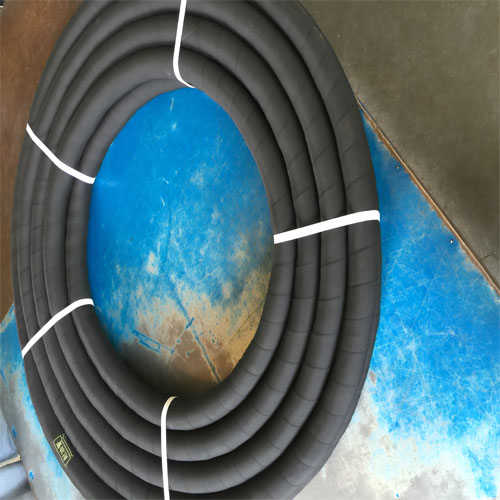
Steam hose with four layers of steel wire winding for enhanced working pressure of 1.8MPa and burst
1、 Engineering logic of 3.3 times blasting allowance: Why does steam hose need four layers of winding
The pressure fluctuations in the steam system are much more severe than those in ordinary hydraulic systems - the instantaneous impact of the steam hammer, the intermittent pressurization of the flat vulcanizing machine, and the water hammer effect caused by the accumulation of condensed water in the pipeline can all cause the pressure inside the pipeline to jump to 2-3 times the working pressure within a few milliseconds. The working pressure of 1.8MPa may seem moderate, but after frequent pressure fluctuations, it imposes strict requirements on the fatigue life of the reinforcement layer.
The four layer steel wire winding structure is precisely the "mechanical redundancy design" to cope with this working condition. Unlike the cross mesh arrangement of steel wires in woven structures, the winding process precisely arranges each layer of high-strength steel wires at a spiral angle of 54 ° -55 °, and forms a solid whole between layers through a high adhesive layer. The inner steel wire provides radial support at a higher angle to resist the bulging deformation of the pipe body under high pressure; The outer steel wire constructs an axial tensile skeleton at a lower angle to prevent excessive elongation of the hose under pulse pressure. The synergistic effect of the four layer structure enables the blasting pressure to reach more than 3.3 times the working pressure (1.8MPa × 3.3=6MPa), providing ample safety margin for instantaneous overpressure in the system.
Taking the four layer steel wire wrapped steam hose as an example, the inner rubber layer is made of heat-resistant EPDM material, the middle is a four layer high-strength steel wire wrapped layer, and the outer layer is weather resistant synthetic rubber. This structure enables it to withstand working pressures ranging from 1.6 MPa to 4.0 MPa, with a burst pressure that can reach more than four times the working pressure. In contrast, the minimum burst pressure corresponding to a working pressure of 1.8 MPa should not be less than 6 MPa, and the design value of the four layer structure is in the range of 6-8 MPa. The safety redundancy meets the long-term reliability requirements of industrial steam transportation.
2、 Four layer winding 'anti pulse code': from spiral angle to interlayer synergy
The working life of steam hoses is not only determined by the initial burst pressure, but also by their ability to resist pulse fatigue - the frequent "heating holding pressure releasing" cycles of the steam system are equivalent to applying continuous periodic loads to the reinforcement layer. The anti pulse advantage of the four layer winding structure comes from the uniformity of interlayer stress distribution.
Each layer of steel wire is wound in alternating directions (left/right) in a spiral pattern, forming an "interlocking" structure between adjacent layers. During pressure fluctuations, the layers deform in coordination rather than sliding relative to each other. This design effectively avoids the problem of "interlayer friction and wear" that is prone to occur in woven structures under high-frequency pulses, allowing the hose to maintain structural integrity after thousands of pressure cycles. According to industry technical specifications, the pulse life of four layer wrapped steam hoses can reach 2-3 times that of woven structures, making them particularly suitable for intermittent operation equipment such as steam hammers and flat vulcanizers.
The material of steel wire is equally crucial. The tensile strength of high carbon steel wire in a four layer structure is usually required to be ≥ 2000MPa, and the surface is treated with copper plating or phosphating to enhance its adhesion with rubber. Under a working pressure of 1.8MPa, high-strength steel wires with a diameter of 0.3-0.5mm are uniformly wound to control the total thickness of the reinforcement layer within the range of 5-8mm, balancing the pressure bearing capacity and installation flexibility.
3、 Application scenarios and security standards: from selection to full cycle management
The practical application of four layer wrapped steam hoses covers multiple fields with strict requirements for high temperature and high pressure, such as food sterilization, rubber vulcanization, and chemical heating. In the flat vulcanizing machine, the hose needs to work continuously for more than 8 hours under saturated steam at 180 ℃ and pressure of 1.8MPa; In the steam blowing system of power plants, it is even more necessary to deal with the "pulse type" working conditions with frequent pressure fluctuations.
In terms of selection points, three key points need to be focused on: firstly, confirm that the working pressure of the hose matches the actual maximum pressure of the system, and the 1.8MPa grade is suitable for most industrial steam systems; Secondly, a blasting pressure of ≥ 3.3 times the working pressure is the minimum requirement for safety redundancy, and a blasting value of 6MPa provides reliable assurance; Thirdly, the working temperature should cover the actual working conditions. The four layer wrapped steam hose can usually withstand a wide temperature range of -40 ℃ to+180 ℃, and some products can reach+220 ℃ saturated steam.
Installation and maintenance standards directly affect the lifespan of hoses. The bending radius of a four layer winding structure is usually 5-8 times the diameter of the pipe - taking the DN32 specification as an example, the minimum bending radius is about 350mm. During installation, it is important to avoid sharp bends that can cause stress concentration in the winding layer. The end joint needs to use a steam specific crimping process, and improper control of the crimping amount may result in excessive stress on the reinforcement layer at the joint. During daily inspections, special attention should be paid to whether the outer adhesive layer has bulges or cracks, and whether the reinforcement layer is corroded and exposed. When the rate of change in outer diameter exceeds 5% or local expansion occurs, it indicates that the inner layer may have been damaged and needs to be replaced immediately.
In summary, the steam hose with four layers of steel wire winding reinforcement, working pressure of 1.8MPa, and bursting pressure of 6MPa, with its ample safety margin of 3.3 times the bursting margin, spiral winding interlayer synergistic anti pulse, and wide temperature range heat-resistant material adaptation, perfectly meets the systematic requirements of industrial steam transportation for "pressure reliability, fatigue resistance, and long life". From the intermittent pressurization of the flat vulcanizing machine to the pulse impact of steam blowing, every structural detail and technical parameter points towards the same goal: to provide a reliable and flexible channel that can withstand pressure and long-term fatigue for heat transfer in the high-temperature and high-pressure steam pipeline network.