
In scenarios such as chemical production, pharmaceutical synthesis, and coating manufacturing, flammable and explosive chemicals such as acetone, methanol, and toluene flow at high speeds in pipelines, and the solid-liquid interface friction generates a large amount of static charges. Ordinary insulated hoses cannot carry away these charges, and the potential continues to rise. Once the energy of electrostatic discharge exceeds the minimum ignition energy of the surrounding flammable vapor (acetone is about 0.2mJ), it may cause a fire or explosion. Conductive anti-static hoses are precisely the solution for this safety requirement - they achieve continuous charge export through the use of a conductive inner lining or embedded with a conductive spiral wire, ensure chemical inertness with corrosion-resistant materials such as PTFE/UPE, and provide compliance with international standards such as EN12115 certification. They have become a safe channel for the transportation of flammable and explosive chemicals that is both corrosion-resistant and anti-static.
News
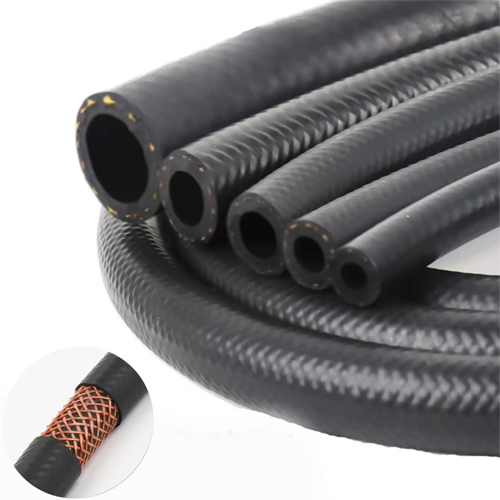
Corrosion resistant chemical conductive anti-static hose for static electricity removal and safe tra
1、 The hazard logic of static electricity and the technical path of conductive anti-static
The accumulation and release of static electricity during the flow of flammable and explosive chemicals in insulated pipelines is a continuous process. According to industry analysis in the field of anti-static, when solids or liquids are transported through rechargeable hoses, the friction between the conveying medium and the pipe wall, as well as the collision between particles, can cause dangerous electrostatic charges to accumulate on the surface of the conveying medium itself and the hose. Once the charge is released, its ignition energy is sufficient to ignite the explosive dust air mixture.
To address this security issue, the industry has developed two mainstream technological paths. The "fully conductive" solution uses a special resin containing conductive fillers to manufacture the inner tube, allowing the current to quickly dissipate through the tube wall, with a resistance as low as R<10 Ω. Representative products include MTG Dynamic SAFE fully conductive PFA hoses. The "embedded conductive structure" scheme involves embedding spiral metal steel or copper wires inside the pipe wall as static electricity export channels, and conducting static electricity away through grounding, representing products such as UPE inner pipes and explosion-proof chemical pipes embedded with copper wires. Regardless of which scheme is adopted, the core is to ensure that the static charges generated by friction can quickly migrate in the continuous structure of the pipeline, rather than accumulating locally to form dangerous potentials.
2、 Corrosion resistant material: chemical inertness and conductive integration of PTFE/UPE lining
Conductive anti-static hoses face dual constraints of "corrosion resistance" and "electrostatic conductivity", and the choice of lining material directly determines the product's medium compatibility and service life.
PFA (perfluoroalkoxy resin) inner tube represents the highest level of corrosion resistance scheme, which can withstand long-term corrosion from strong acids, strong bases, and most organic solvents, including aqua regia, hydrofluoric acid, and halogenated hydrocarbons. The MTG Dynamical SAFE series uses perfluorinated PFA inner tube with smooth mirror finish and black anti-static material, with a resistance of R<10 Ω. It has passed USP Class VI, FDA and other certifications and is suitable for the pharmaceutical and flammable and explosive chemical industries. Its working pressure reaches 10 bar (about 1.0 MPa), and the burst pressure is four times the working pressure, which can cover the vast majority of chemical transportation scenarios.
UPE (ultra-high molecular weight polyethylene) lining balances corrosion resistance and wear resistance. The Galton TALOS UPE fully conductive explosion-proof chemical tube adopts a black conductive UPE inner layer, which complies with FDA certification. The internal adhesive resistance is R<10 ⁶ Ω, and the external adhesive resistance is R<10 ⁹ Ω. The working pressure is 16 bar (about 1.6 MPa), and the explosion pressure is 64 bar, meeting EN12115 anti-static requirements. It has passed ATEX explosion-proof certification and can be used in explosion-proof environments. Manichem UPE hoses also comply with EN12115:2011 standard, with fully conductive inner, outer, and pipe walls to ensure safe dissipation of static electricity.
3、 Standard Certification and Explosion proof Application: The Road to Compliance with EN12115 and ATEX
The selection of conductive anti-static hoses not only depends on material performance, but also needs to comply with the international explosion-proof standard system.
EN12115:2011 is the core standard of the European Union for the static dissipation performance of hoses, which stipulates that hose design should ensure the dissipation of surface static electricity and the rapid dissipation of current through the pipe wall. The hose resistance requirements that meet this standard are strict - the fully conductive hose resistance of MTG Dynamic SAFE is R<10 Ω, and the internal rubber resistance of UPE scheme is R<10 ⁶ Ω, and the external rubber resistance is R<10 ⁹ Ω. The order of magnitude differences in these resistance values reflect the design orientation of different conductivity schemes, but the commonality is that they can effectively prevent the accumulation of dangerous charges.
ATEX explosion-proof certification is another key compliance indicator. TALOS UPE hoses are clearly labeled as "compliant with explosion-proof certification and suitable for use in explosion-proof environments". Masterflex's conductive hoses also comply with TRGS 727 and ATEX standards, requiring the hoses to be grounded through a metal containing spiral coil to ensure static dissipation. In practical applications, when transporting and loading/unloading flammable and explosive liquids, pipelines need to be equipped with good electrostatic grounding facilities, and the flow rate should be slowly controlled to avoid static electricity generation.
The selection criteria need to take into account three dimensions: firstly, evaluate the corrosiveness level of the transported chemicals and choose PFA, UPE, or PTFE lining; Secondly, confirm the conductivity requirements. The fully conductive type is suitable for the highest explosion-proof level, while the spiral embedded type is suitable for conventional scenarios; Thirdly, pay attention to the matching of connectors and grounding to ensure that the end of the hose can be reliably grounded. Before use, it is necessary to confirm the grounding continuity. During daily inspections, it is necessary to regularly test the resistance value to ensure the long-term effectiveness of anti-static performance.
In summary, the corrosion-resistant chemical conductive anti-static hose, with its PTFE/UPE lined chemical inert barrier, fully conductive/embedded spiral type electrostatic discharge design, and EN12115 and ATEX standard certification compliance guarantee, perfectly meets the systematic safety requirements of "corrosion resistance, electrostatic conductivity, and explosion prevention" for the transportation of flammable and explosive chemicals. From the frictional electrification of acetone to the accumulation discharge of methanol, from the fully conductive PFA with R<10 Ω to the UPE scheme with R<10 ⁶ Ω, every resistance value and material selection points towards the same goal: to minimize the risk of electrostatic explosion in hazardous areas of chemical plants.