
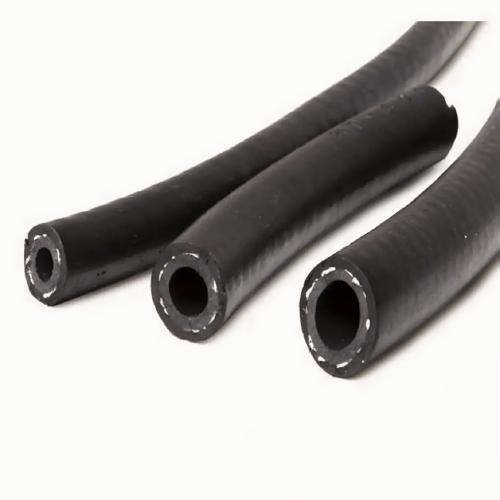
In many industrial production and specific civilian scenarios, high-temperature steam is an indispensable energy and process medium. From the heating steam used to drive reactions in the chemical industry, to the high-temperature steam used for sterilization and disinfection in the food processing industry, and to the steam used to transport heat in heating systems, it is widely used and plays a critical role. However, when the steam temperature reaches 180 ℃, traditional steam hoses face severe challenges, exposing many insurmountable limitations and difficulties.
Traditional steam hoses often use ordinary rubber or some synthetic materials that are not resistant to high temperatures in material selection. These materials undergo significant changes in their molecular structure under high temperature conditions. Taking ordinary rubber as an example, at a high temperature of 180 ℃, the rubber molecular chains will rapidly relax, leading to a sharp decline in its physical properties. Rubber, which originally had good elasticity and flexibility, will gradually become harder and brittle, with significantly reduced tensile strength and elongation at break. This makes the hose prone to expansion, deformation, and even rupture when subjected to steam pressure.
In terms of structure, traditional hoses often lack effective reinforcement designs. They are mostly single-layer structures and do not have sufficient strength to withstand the enormous pressure generated by high-temperature steam. When high-temperature steam at 180 ℃ flows inside the hose, it will generate high pressure fluctuations, and the single-layer structure of the hose cannot evenly distribute these stresses, resulting in local stress concentration. During long-term use, these stress concentration points will gradually become weak links in the hose, eventually causing hose rupture and steam leakage.
In some chemical companies' steam heating reaction kettle systems, there have been frequent occurrences of traditional hoses bursting due to their inability to withstand 180 ℃ high temperature steam. The burst hose not only causes a large amount of steam leakage, resulting in energy waste, but also causes the temperature and pressure inside the reactor to lose control, affecting production progress and product quality. More seriously, the leaked high-temperature steam also poses a threat to the personal safety of on-site workers, causing safety accidents such as burns.
Advantages of EPDM material: Stable performance guarantee at high temperatures
The key to the stable operation of high-temperature steam EPDM hoses at 180 ℃ is the unique advantage of the EPDM (ethylene propylene diene monomer) material used.
The molecular structure of EPDM rubber endows it with excellent high temperature resistance. Its main chain is composed of saturated carbon carbon single bonds, and this stable structure makes EPDM rubber less prone to thermal decomposition and oxidation reactions at high temperatures. In a continuous high temperature environment of 180 ℃, EPDM rubber can still maintain good flexibility and elasticity, and will not become hard or brittle like ordinary rubber. This enables the hose to effectively maintain its shape and size stability when subjected to the pressure of high-temperature steam, reducing the risk of rupture caused by expansion deformation.
In addition to high temperature resistance, EPDM rubber also has excellent aging resistance. In a high-temperature steam environment, hoses are not only affected by high temperatures, but also corroded by oxygen, moisture, and possible chemical substances. These factors will accelerate the aging process of the hose and shorten its service life. EPDM rubber can resist the effects of these adverse factors, and the special functional groups in its molecular structure can effectively resist oxidation and chemical corrosion, making it less prone to aging, cracking, and other phenomena after long-term use. This enables high-temperature steam EPDM hoses to maintain long-term stable performance in complex working environments, reducing the frequency of hose replacement and lowering usage costs.
In addition, EPDM rubber also has good sealing performance. The sealing between the hose and the joint is crucial at a high temperature of 180 ℃. The flexibility and elasticity of EPDM rubber enable it to tightly adhere to the joint, forming a reliable sealing structure to prevent steam leakage. Even under the dual effects of high temperature and high pressure, EPDM rubber can still maintain good sealing performance, ensuring the safety and efficiency of steam transmission.
Multi domain application value: the ideal choice for industrial and civilian use
Industrial production field: supporting efficient and stable production
High temperature steam EPDM hoses play an important role in industrial production. In the chemical industry, many chemical reactions require specific temperature and pressure conditions, and high-temperature steam at 180 ℃ is often used to heat reaction vessels. This hose can safely and reliably transport high-temperature steam to the reaction vessel, ensuring precise control of reaction temperature, improving reaction efficiency and product quality. In the pharmaceutical industry, high-temperature steam is used for sterilization and drying processes of drugs. The use of high-temperature steam EPDM hoses can ensure the purity and stability of steam, avoid drug contamination caused by hose problems, and comply with strict hygiene standards in the pharmaceutical industry.
Energy supply sector: Ensuring the safety of energy transmission
In the field of energy supply, such as thermal power plants and district heating systems, high-temperature steam needs to be transported to various user ends through pipelines. High temperature steam EPDM hose, as an important component of steam transmission pipelines, can withstand the pressure and temperature changes of 180 ℃ high temperature steam, reducing steam leakage and energy loss. Its excellent flexibility and corrosion resistance enable the hose to adapt to complex pipeline layouts and harsh working environments, ensuring the safety and efficiency of energy transmission.
Civilian sector: Improving quality of life and safety
In the civilian field, high-temperature steam EPDM hoses are also widely used. In the hotel's heating system, using this hose to transport high-temperature steam can provide a comfortable and warm environment for guest rooms. Its reliable sealing performance and high temperature resistance can prevent steam leakage and avoid scalding accidents. In the kitchen equipment of the food processing industry, high-temperature steam is used for cooking and disinfecting food. High temperature steam EPDM hoses can ensure stable steam supply, guarantee food hygiene and safety, and provide protection for people's dietary health.
High temperature steam EPDM hose, with its excellent high temperature resistance, stable material characteristics, and wide application value, has become an ideal steam transmission rubber hose that can work continuously in a high temperature environment of 180 ℃, bringing many conveniences and safety guarantees to industrial production and civilian life.