
In industrial scenarios such as chemical plant tank areas, hazardous chemical transportation vehicles, smelting workshops, and environmental desulfurization, the loading, unloading, and transportation of corrosive media such as strong acids and alkalis pose extremely demanding requirements on pipeline materials. Ordinary rubber hoses can experience swelling, hardening, and even perforation and leakage of the inner rubber layer within a few weeks under continuous erosion by concentrated sulfuric acid, hydrochloric acid, or liquid alkali. The large-diameter suction and discharge acid and alkali rubber hose is a professional product developed to address this pain point - it uses EPDM/PTFE corrosion-resistant lining to construct a chemical barrier, and multiple layers of fiber/steel wire reinforcement layers to carry alternating positive and negative pressures. It is equipped with standardized flanges/quick connectors to adapt to tank truck loading and unloading, becoming a "safety guard" in the field of corrosive medium transportation.
News
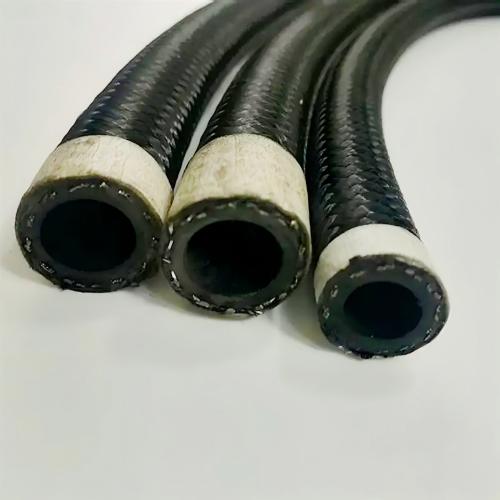
Large caliber acid and alkali suction and discharge hose, resistant to chemical corrosion, suitable
1、 Corrosion resistant password: "Chemical firewall" constructed with EPDM and PTFE
The chemical properties of acidic and alkaline media are extremely active, requiring high selectivity for rubber materials. When transporting sulfuric acid, 3% hydrochloric acid, and 15% sodium hydroxide solutions with concentrations not exceeding 40%, conventional acid and alkali resistant rubber hoses use ethylene propylene diene monomer (EPDM) as the base material for the inner rubber layer. The main chain of EPDM molecules is composed of saturated carbon carbon bonds, without double bonds that are susceptible to chemical attacks, giving it excellent acid, alkali, ozone, and aging resistance.
For more demanding working conditions, the industry-leading solution is to use polytetrafluoroethylene (PTFE) lining. PTFE is known as the "plastic king", and its extremely stable carbon fluorine bond allows it to "insulate" almost all chemical substances except for molten alkali metals and fluorine elements. When transporting 98% concentrated sulfuric acid, nitric acid, and various organic solvents, PTFE lining does not experience any swelling, dissolution, or cracking. According to industry product parameters, the working temperature range of this type of lining can reach -55 ℃ to+200 ℃, suitable for all scenarios from low-temperature workshops to high-temperature reactors.
When the conveying medium contains abrasive particles (such as crystalline salts in electroplating solutions), UHMWPE (ultra-high molecular weight polyethylene) lining can also be used, which has 3-5 times the wear resistance of ordinary rubber and excellent chemical corrosion resistance. This customized design of "one pipe, one formula" - EPDM adapts to dilute acid and alkali, PTFE is resistant to strong acids, and UHMWPE balances abrasion and corrosion - enables large-diameter suction and discharge hoses to meet the diverse needs of chemical plant tanker loading and unloading.
2、 Structural skeleton: Conquering the "combination of rigidity and flexibility" design with alternating positive and negative pressure
The loading and unloading operations of chemical plant tank trucks have a typical "positive and negative pressure alternation" feature: during unloading, a hose connects the outlet of the tank truck to the inlet of the storage tank, and the pipe is subjected to positive pressure pumping; When loading, the hose connects the outlet of the storage tank to the inlet of the tanker, and negative pressure may be generated inside the pipe due to suction. Ordinary boneless hoses are prone to being "sucked flat" under negative pressure, leading to pipeline blockage and even equipment damage.
According to heavy material suction and discharge pipe standards such as HG/T 2192, the reinforcement structure of large-diameter acid-base rubber hoses adopts a composite system of "inner rubber layer multi-layer impregnated curtain fabric/fiber weaving layer spiral steel wire skeleton outer rubber layer". The multi-layer curtain fabric reinforcement layer is cross wound with polyester or nylon cord, with strong interlayer adhesion, providing the basic tensile and blast strength for the pipe body; The spiral steel wire skeleton is embedded inside the pipe wall, like the "vertebrae" of the pipe, providing continuous radial support during vacuum suction.
Taking a DN400mm (16 inch) large-diameter acid and alkali resistant rubber hose from a certain manufacturer as an example, its vacuum pressure can reach 80Kpa (about -0.08MPa), ensuring that the hose does not collapse at the suction end of the tanker pump. Under positive pressure conditions, the working pressure of this specification of rubber hose is 0.7-1.2MPa, and the burst pressure reaches 4 times the working pressure (safety factor 4:1), which meets the internationally recognized safety standards. Some high-performance models, such as the ACIDKEM D series, have a working pressure of up to 20 bar (approximately 2.0 MPa), which can cover the vast majority of tanker loading and unloading scenarios.
The outer rubber layer also reflects professional design - using weather resistant and ozone resistant EPDM synthetic rubber, the cloth pattern appearance has a higher density than general smooth rubber hoses, the overall integrity of the pipe body is better, and it can resist acid and alkali aerosols, sun and rain, and mechanical scratches in chemical plants. This design concept of "combining rigidity and flexibility" enables large-diameter rubber hoses to possess both the compressive strength of "hard walls" and the flexibility of "soft walls".
3、 Tank truck adaptation: a system solution from quick connection to safe loading and unloading
The operational characteristics of chemical plant tank trucks are "fast" - tank trucks have limited time to stay in the loading and unloading area, requiring hoses to have fast connection and retraction capabilities. At the same time, high-risk media such as hydrochloric acid, sulfuric acid, and liquid alkali require extremely high sealing performance, and any leakage may cause serious safety accidents.
Standardized interfaces are the key to improving loading and unloading efficiency. Large caliber acid and alkali suction and discharge rubber hoses are commonly equipped with carbon steel or 304 stainless steel flange joints at both ends. The flange surface can be selected in the form of raised face (RF) or full flat face (FF), combined with EPDM or PTFE gaskets, to achieve zero leakage operation under a working pressure of 1.0-2.0MPa. Some products are also compatible with specialized quick couplings for tank trucks. Simply align and lock the couplings, without the need to tighten bolts or weld, and connect a single hose in 3-5 minutes, greatly reducing loading and unloading time.
The coverage range of the inner diameter reflects the adaptability of the product to different scenarios. The inner diameter of large-diameter acid and alkali suction and discharge rubber hoses can cover from DN13mm (1/2 inch) to DN600mm (24 inches), with a standard length of 20 meters per hose. Non standard lengths can also be customized according to the layout of the tanker loading and unloading platform. DN50-DN150 (2-6 inches) is the mainstream specification for tank truck loading and unloading, which can match the size of commonly used tank truck unloading ports; A super large diameter of DN200 or above is suitable for batch loading and unloading operations in large storage tank areas.
Safety regulations cannot be ignored either. Operators must wear protective clothing, goggles, and acid alkali resistant gloves when using acid alkali rubber hoses; The hose should not be used beyond the temperature and pressure range recommended by the manufacturer. The HG/T 2192 standard also specifies the requirements for fatigue testing, leakage testing, and corrosion testing of hoses - hoses with a wear of ≤ 0.3mm can only pass verification after washing the inner rubber layer with 2mm diameter quartz sand at a speed of 5m/s for 24 hours. These rigorous testing standards ensure the long-term reliability of rubber hoses in chemical plant tanker loading and unloading scenarios.
4、 Summary
In summary, the large-diameter suction and discharge acid and alkali rubber hose, with its EPDM/PTFE/UHMWPE corrosion-resistant lining chemical stability, multi-layer curtain wire+spiral steel wire reinforced rigidity and flexibility, and standardized flange/quick connector tank truck adaptation, perfectly meets the strict requirements of chemical plant tank truck loading and unloading for "corrosion resistance, positive and negative pressure resistance, and quick connection". From dilute sulfuric acid to concentrated hydrochloric acid, from room temperature liquid alkali to high-temperature solvents, this "chemical vessel" carries the safe flow of corrosive media, providing a solid and flexible guarantee for the efficient operation of the chemical industry.